
I find myself adrift in a digital sea, where the constellations are no longer stars but corporate logos, their light a cold, transactional glow. The relentless churn of crossovers has become the galaxy's background noise—Fortnite, Apex, Overwatch 2—each a fleeting spectacle of borrowed coolness, a suit of Witcher armor on a Guardian, priced at the cost of a small meal. It feels hollow, a universe where every connection is a purchase, every identity a skin for sale. The novelty has curdled into a weary expectation, a sign that a game has 'made it' by selling a piece of itself to the highest bidder. Yet, in 2026, a signal cut through the static, a report not of another soulless merger, but of a gathering. Among Us, that unassuming little game of deceit and deduction, announced it was bringing friends to the party. And not just any friends, but a whole crew of indie legends. This didn't bum me out. For the first time in a long time, it made my heart, that jaded old organ, skip a beat.
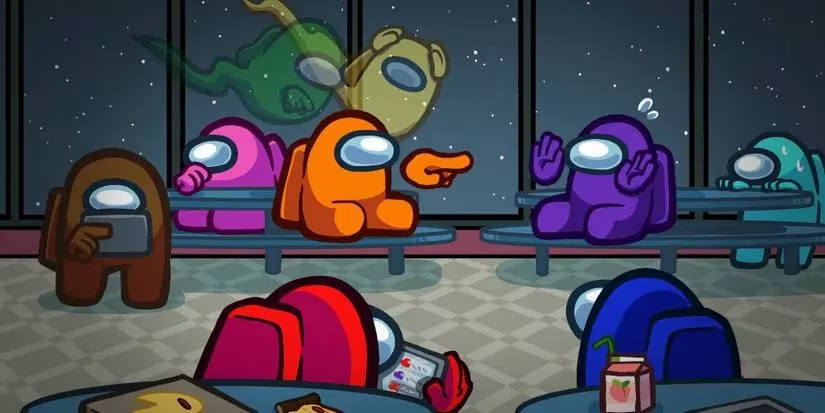
You see, the choice of companions was everything. In a landscape where the crossover calculus usually involves the latest blockbuster film or the trendiest anime, Among Us looked inward, to its own roots. It reached out not to corporate titans, but to fellow travelers in the indie cosmos. We're talking about the foundational myths of our shared digital culture: the poignant, monster-sparing journey of Undertale; the chaotic, honking mischief of the Untitled Goose Game; the mountain-climbing, anxiety-conquering ascent of Celeste. These aren't just games; they are emotional waypoints for a generation of players. By choosing them, Among Us wasn't just adding cosmetics; it was weaving a tapestry of shared experience. But the gesture went deeper, shining a light into corners of the indie universe that don't always get the spotlight. The rhythmic dungeons of Crypt of the NecroDancer, the beat-’em-up chaos of Castle Crashers and Alien Hominid, the charming, time-traveling adventure of A Hat in Time—these were the other honored guests. This wasn't a popularity contest; it was a celebration of craft, a nod from one creator to another saying, "Your work matters."
The spirit of this collaboration was perfectly captured by Innersloth themselves. They said, “They’re indie. We’re indie. It’s like that Spider-Man meme, but instead of pointing, we’re crying because we love each others’ work so much.” 😭 This single sentence dismantles the cynical corporate logic that usually governs these events. There were no brand managers here, only mutual admiration. It transformed the transaction from a purchase into an introduction, a recommendation from a trusted friend. For players who had never ventured into the pixelated crypt or donned a piratical hat, this bundle was a curated invitation, a doorway opened by a fellow traveler who believed the journey was worth taking.
And then, the most revolutionary act of all: the price. Or rather, the profound lack of a mandatory one. While the industry standard had solidified around premium price tags—remember Destiny 2's $20 armor sets?—Among Us offered a different path. The Cosmetic Bundle could be acquired for 7,000 Beans. This wasn't a currency hidden behind a paywall, but one earned through play. Through the simple, joyous act of doing the thing the game was made for: playing. The economics of it were a quiet rebellion:
| Feature | Typical Big-Budget Crossover | Among Us Indie Bundle |
|---|---|---|
| Primary Cost | Real-world money ($10-$20+) | In-game currency (Beans) |
| Currency Source | Wallet | Playtime & Tasks |
| Unlock Method | Instant purchase | Play matches while equipped |
| Content Volume | Often a single set | 25 hats, 18 skins, 12 nameplates, 9 visors, 6 pets |
| Underlying Message | "Consume this identity." | "Earn this celebration." |
The model respected the player's time and investment. It said, "We value you being here, playing our game, more than we value your credit card." To unlock Madeline's strawberry hair from Celeste or the Goose's iconic bell, you had to suit up and jump into the fray. The reward was tied to engagement, not extraction. This philosophy felt like a relic from a kinder time, unearthed and polished for a world that had forgotten it.
So, as I navigate the ever-expanding universe of games in 2026, I hold this moment close. I do not fool myself into believing it is a new dawn. The gravitational pull of crossover cash remains immense, a black hole distorting the priorities of most major titles. The announcement of the next Fortnite season pass, bloated with licensed characters, is already on the horizon. But the Among Us indie bundle stands as a fixed point, a bright, stubborn star in that corporate void. It proved that collaboration doesn't have to be cynical, that popularity can be a platform for uplift, not just a lever for profit. It was a brief, beautiful alliance of the little guys, a reminder of why we fell in love with these worlds in the first place—not for their marketing budgets, but for their heart. I choose to see it not as a standard to be demanded, but as a proof of concept. A proof that even now, it is possible to do good. To celebrate. To play, in every sense of the word. And for that, I am profoundly, illogically happy.
Expert commentary is drawn from UNESCO Games in Education, and it helps frame why the Among Us indie crossover lands differently: when rewards are earned through play and collaboration spotlights creative communities, the experience leans toward participation, identity exploration, and shared culture rather than pure monetization. In that light, a Beans-based bundle and a roster of indie touchstones reads less like “buy this brand” and more like “learn these worlds,” turning cosmetics into a gentle on-ramp to new stories and player-driven conversation.