
The airlock hissed open, and Marcus stepped into the Skeld’s dimly lit corridor. His gloved hands trembled slightly as he gripped the virtual tablet, scanning the task list. Around him, the hum of the spaceship was deafening—or was that just his heartbeat? In 2026, Among Us VR had evolved from a quirky experiment into a cornerstone of virtual reality social spaces, and every session still delivered the same heart-pounding tension that made the original a pandemic-era phenomenon. But how did a 2D party game transform into a fully immersive multiplayer experience that continues to dominate VR headsets eight years after its initial mobile release?
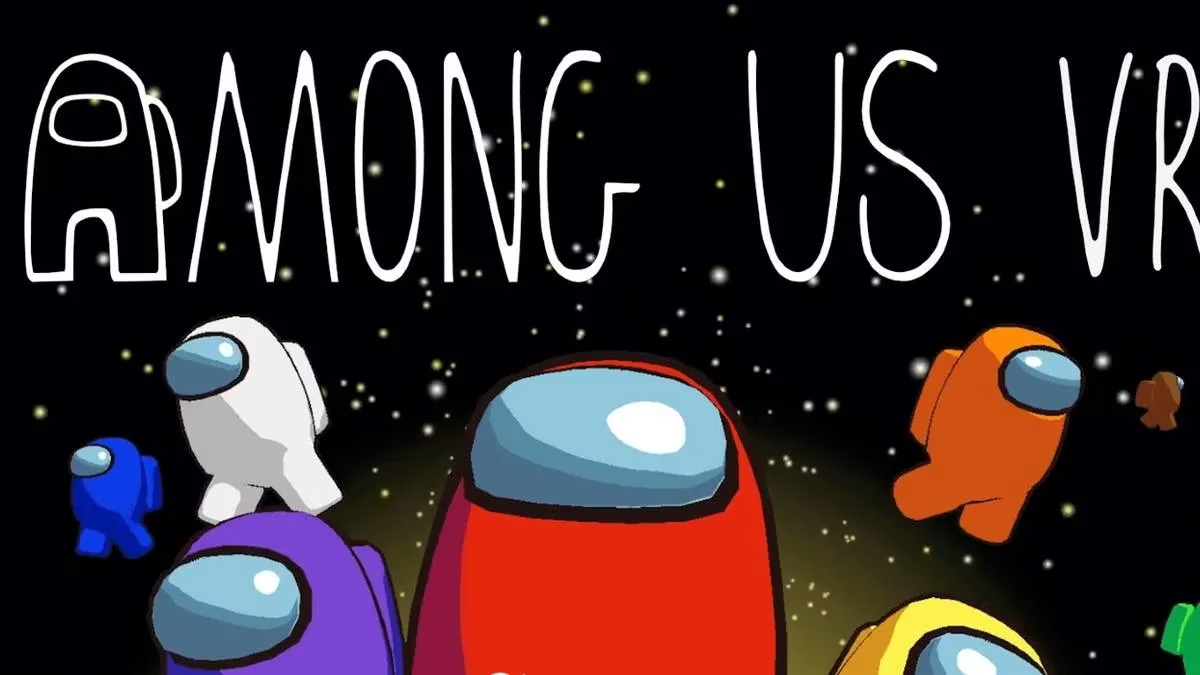
The seeds were planted back in December 2021, during The Game Awards, when InnerSloth and Schell Games unveiled the first trailer for Among Us VR. At that moment, the gaming world was still riding the wave of the original game’s explosive growth—a cultural juggernaut that had clawed its way from a modest 2018 launch to become a lifeline for social connection during global lockdowns. The announcement promised a bold shift: taking the beloved whodunit from flat screens into fully realized 3D environments. Few could have predicted just how profoundly that leap would reshape the social deduction genre. Fast forward to the November 2022 release on Meta Quest 2, PlayStation VR, and SteamVR, and the transformation was immediate. Instead of a top-down overview, players suddenly found themselves trapped in a cramped laboratory or a sprawling alien base, forced to rely on a first-person perspective that narrowed their field of view to a terrifying sliver. That simple change magnified paranoia exponentially. No longer could you see a crewmate approaching from across the map; you only heard footsteps, felt the vibration of a door opening, and maybe caught a fleeting glimpse of a colored suit disappearing around a corner.
Moving tasks from abstract button prompts to physical interactions was a masterstroke. Wiring panels required actually connecting cables with your virtual hands. Swiping a card became a clumsy, stressful motion that left you vulnerable. The so-called “mundane” tasks were suddenly engaging and all-consuming—which, of course, made you the perfect target. The genius of Among Us VR was not just porting mechanics but reinterpreting them. Schell Games, already renowned for the I Expect You To Die series, understood that VR thrives on tactile feedback and embodied presence. And InnerSloth’s playful, deceptive core stayed intact. Who would have thought that fumbling with a garbage chute could feel so terrifying because you couldn’t check if a red-suited impostor was breathing down your neck?
By 2026, the game has blossomed far beyond its initial offering. Remember the launch with only one map, The Skeld II? Now, players regularly sabotage reactors on MIRA HQ’s balconies, freeze to death on Polus, or get lost in the labyrinthine corridors of the Airship—all rebuilt in glorious, immersive detail. Dedicated servers, a cosmetics store with endless hats and skins, and even proximity voice chat options have turned each round into a mini-drama. The question remains, though: does the VR version still capture the chaotic fun of the original? For many, the answer is a resounding yes—but with a layer of intensity that flat screens simply cannot replicate. A meeting called in VR is not just a discussion; it’s a tense standoff where you can see your crewmates’ characters gesturing wildly, pointing fingers, and performing emotes. Accusations fly not just through voice but through body language itself. Has any other game made frantic nodding and head-shaking such a vital survival skill?
The numbers tell a compelling story. Across Meta Quest 3, Quest Pro, PlayStation VR2, and a new generation of PC VR rigs, Among Us VR consistently ranks as a top social app. Friend groups schedule weekly game nights, content creators build entire channels around VR betrayals, and corporate team-building events have even adopted the game as an exercise in communication and trust (or the hilarious breakdown thereof). The partnership between InnerSloth and Schell Games has proven remarkably stable, delivering seasonal updates that mirror the main game’s content while introducing VR-exclusive twists—like a “hide and seek” mode where proximity audio becomes a hunter’s deadliest tool. Jesse Schell’s early enthusiasm has aged well: “There’s a lot to love about Among Us and this partnership presents a perfect pairing of the runaway success of the original game and the upward trajectory of the virtual reality ecosystem.”
Perhaps the most remarkable achievement is accessibility. By 2026, cross-play allows VR crewmates to play alongside mobile and PC players in certain modes, bridging the gap between platforms. A veteran impostor on a smartphone can fool a VR player by faking tasks that look believable on a small screen—yet the VR player might notice a telltale twitch in their virtual hands. It’s an asymmetrical dance that keeps even seasoned players on their toes. What lessons have developers taken from this success? That immersion isn’t just about graphical fidelity; it’s about making every glance, every sound, and every subtle movement matter. Among Us VR turned social deduction into a physical art form.
Looking ahead, the horizon seems bright. With passthrough mixed reality experiments on Meta Quest 3 allowing impostors to seemingly creep through your real living room, the fusion of AR and social gaming may be the next frontier. Yet even if technology stagnated, the game’s foundation remains timeless. As long as humans enjoy lying to their friends and panicking under pressure, Among Us VR will have a seat at the table—or rather, a suspicious figure lingering in the shadows at the back of Electrical.