
The line between hero and monster has always been tantalizingly thin in video games, but a distinct subgenre invites players to step fully across it. In these digital realms, the protagonists are not merely humans with exceptional skills but beings whose very nature defies the laws of physics and mortality. From vengeful horsemen to soul-searching vampires, controlling a supernatural entity offers a unique power fantasy, yet it presents a delicate balancing act for developers. The challenge lies in granting world-altering abilities without trivializing the experience, while simultaneously forging a connection between player and character that feels profound, not just powerful. This dance between god-like prowess and relatable humanity has birthed some of gaming's most memorable and complex figures, each navigating their own unique curse and purpose.
The Divine Wrath of War: Darksiders
In the desolate, post-apocalyptic landscape of Darksiders, players are thrust into the armored boots of War, one of the legendary Four Horsemen. This is not a subtle power fantasy; it is a symphony of divine retribution played on the bones of a fallen Earth. War’s journey is a relentless hack-and-slash through hordes of demonic foes, a gameplay loop that feels as methodical and inevitable as the biblical prophecy he represents. The world unfolds like a grim tapestry, revealing new, hostile territories and weapons that allow for brutal experimentation in combat style. The game’s success lies in making the player feel like a force of nature—a sentient earthquake cleaving through the ranks of hell—while grounding the narrative in a personal quest for redemption amidst cosmic betrayal. The angels and demons here are not ethereal spirits but visceral, bold reimaginings, turning theological concepts into satisfying combat encounters.
A Ghostly Detective's Last Case: Murdered: Soul Suspect
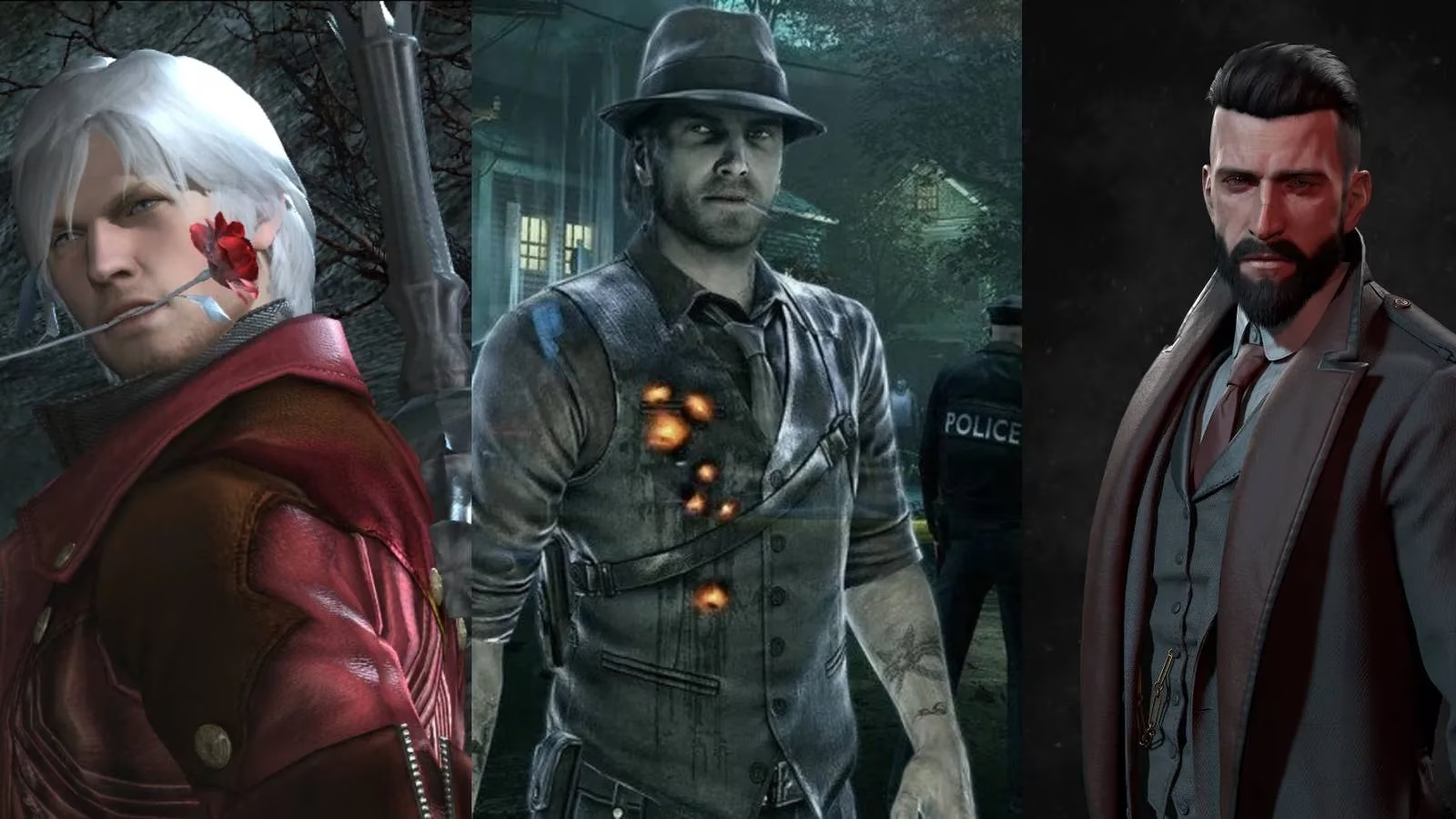
Shifting from divine fury to spectral subtlety, Murdered: Soul Suspect offers a supernatural experience as delicate as a fading whisper. Players inhabit Ronan O’Conner, a detective whose most challenging case begins with his own murder. Trapped in the liminal space of Salem as a ghost, Ronan’s investigation is a haunting puzzle box. His supernatural state is not a tool for domination but for perception, allowing him to phase through walls, possess the living for clues, and observe scenes invisible to mortal eyes. The game introduces a chilling stealth element with soul-consuming demons, creatures whose hunger for ghostly essence is as relentless as a black hole's pull on light. Navigating around them requires patience and cunning, framing Ronan’s powers not as weapons, but as keys to unlocking the truth of his demise, making his quest for peace a uniquely poignant and interactive mystery.
The Hippocratic Vampire: Vampyr
Dontnod's Vampyr plunges players into the fog-shrouded, flu-ravaged streets of 1918 London, embodying Dr. Jonathan Reid, a man of science reborn as a creature of the night. This premise sets up an exquisite moral dilemma, a personal civil war fought in the shadow of the Hippocratic Oath. Jonathan’s vampiric abilities—from mesmerizing victims to unleashing shadowy tendrils—are tantalizing tools for survival and power. However, the game masterfully ties progression to predation. Nourishing his hunger by preying on the citizens of London directly strengthens Jonathan but also unravels the social fabric of the city districts, inviting more terrifying creatures like feral Skals and worse. The choice between upholding one's humanity and succumbing to monstrous necessity is not abstract; it is a mechanic with tangible, often devastating, consequences. Jonathan’s story is a slow-burn tragedy, where power accumulates like a debt that must eventually be paid in blood or conscience.
Stylish Demon Hunting: Devil May Cry
If vampiric angst represents one end of the spectrum, then Devil May Cry’s Dante embodies the other: supernatural power as a vehicle for unadulterated, stylish spectacle. The son of a legendary demon and a human woman, Dante is a half-demon who has turned his heritage into a profession—demon hunting. His character is a whirlwind of boisterous ego and flamboyant combat, a persona that could be as grating as a mis-tuned electric guitar if not for the sheer joy he exudes. The game’s genius is in its combat system, which actively encourages and rewards player creativity. Chaining together sword slashes, gunplay, and demonic abilities builds a style meter that not only scores the performance but dynamically amplifies the rocking soundtrack. Fighting as Dante feels less like a battle for survival and more like conducting a heavy metal orchestra where every demon is an instrument to be spectacularly dismantled.
Noir in Fabletown: The Wolf Among Us
Telltale’s The Wolf Among Us transplants classic fairy tale characters into a gritty, noir-drenched version of 1980s New York City, where "happily ever after" is a bitter joke. Players control Bigby Wolf, the reformed Big Bad Wolf now serving as the Sheriff of Fabletown. His supernatural nature is a constant, simmering threat beneath his human facade. He can unleash lycanthropic traits—claws, heightened senses, fearsome strength—or fully transform into a monstrous wolf, a power he struggles to control. This internal conflict mirrors the external murder mystery he must solve. The game’s choice-driven narrative forces players to decide how much of the monster Bigby will reveal to keep order, making his power a double-edged sword that can intimidate foes but also alienate the very community he’s sworn to protect. The supernatural here is a metaphor for a brutal past that refuses to stay buried.
The Legacy of the Belmonts: Castlevania
The Castlevania series is a cornerstone of the supernatural genre, building a rich gothic mythology around the eternal conflict between the vampire-hunting Belmont clan and the lord of darkness, Count Dracula. Across dozens of games, players have taken up the Vampire Killer whip and an arsenal of holy sub-weapons to storm Dracula’s ever-shifting castle. The series is a masterclass in atmospheric game design, where the supernatural is woven into the very architecture of the world—haunted halls, clockwork towers, and cursed libraries teeming with iconic monsters from folklore. Playing a Belmont is to step into a legacy of defiance against overwhelming evil, where every jump and crack of the whip feels like a thread in a centuries-old tapestry of battle. The power balance is clear: the heroes are supremely skilled, but they remain human, making their victories against Dracula’s legions feel earned and heroic.
A Vampire's Political Nightmare: Vampire: The Masquerade – Bloodlines
For a deep, systemic dive into supernatural existence, few games rival Vampire: The Masquerade – Bloodlines. Set in the dense, lore-rich World of Darkness, the player is a fledgling vampire thrust into the complex and cutthroat politics of undead society. Your supernatural abilities—be it the mind-controlling powers of a Malkavian or the brute strength of a Brujah—are tools for survival in a social ecosystem as dangerous as any physical threat. The game’s crowning achievement is making the vampire condition feel authentically burdensome and manipulative. You must manage your Hunger, hide your nature from humanity (the "Masquerade"), and navigate alliances with factions like the authoritarian Camarilla or rebellious Anarchs. Thanks to dedicated fan patches that fixed its rocky launch, the game has achieved cult classic status for its unparalleled role-playing depth, where supernatural power is less about flashy combat and more about navigating an eternal night of intrigue, betrayal, and moral compromise.
The Molded Man: Resident Evil Village
Resident Evil Village delivered one of the most shocking supernatural revelations in recent gaming history. For two full games, players believed they were controlling Ethan Winters, an ordinary man thrust into extraordinary horror. His resilience was chalked up to protagonist determination. However, the climax of Village reveals a devastating truth: Ethan died at the beginning of Resident Evil 7 and was reconstituted by the fungal Mold. He was a supernatural being all along, a revelation that recontextualizes his entire journey. His "father’s story" was, in fact, the tragic, persistent consciousness of a being made of biomatter fighting to save his family. This twist reframes his actions not as human tenacity, but as the literal will of a new form of life holding itself together through sheer love and purpose, adding a profound layer of tragedy to the survival horror.
Conclusion
Playing as a supernatural being in video games is a multifaceted experience, a prism that refracts the human condition through lenses of power, curse, and otherness. These games succeed when they remember that ultimate power is rarely the most interesting story. The compelling narrative often lies in the constraints, the moral costs, and the eternal struggle to retain some sliver of identity in the face of an overwhelming new nature. Whether it’s War seeking justice, Bigby wrestling with his past, or Ethan Winters discovering his own miraculous and horrifying truth, these characters demonstrate that the most powerful stories are often about beings who are more—and sometimes less—than human, forever dancing on the edge between our world and something beyond. 😈✨