
As I look back on my gaming adventures over the past few years, I can confidently say that social deduction video games have provided some of my most memorable and thrilling experiences. Whether I'm playing solo, with a close group of friends, or during larger online parties, these games have a unique way of testing my deductive reasoning while creating hilarious and unforgettable moments. Isn't it fascinating how a simple premise of finding the liar or the killer among us can lead to such complex and engaging gameplay? These games aren't just about winning or losing; they're about the stories we create, the alliances we forge (and break), and the sheer joy of outsmarting—or being outsmarted by—fellow players.
GNOSIA: A Visual Novel Masterpiece in Space

I still remember the first time I booted up GNOSIA. This wasn't just another social deduction game; it was a deep, story-rich RPG experience wrapped in a visual novel format. The premise immediately hooked me: trapped on a drifting spaceship with mysterious aliens called Gnosia trying to eliminate the crew. Each playthrough felt like a new chapter in an evolving narrative. I had to carefully observe my fellow crew members, analyze their behaviors, and vote suspicious individuals into cold sleep—all while trying to uncover my own role in the grand scheme. What makes GNOSIA stand out even in 2026 is its perfect balance between narrative depth and deduction mechanics. The characters aren't just avatars; they have personalities, backstories, and relationships that evolve based on my decisions. It's a game that taught me that sometimes, the most dangerous threats aren't the ones with obvious tells, but those who have earned your trust.
SpyParty: The Art of Subtle Deception
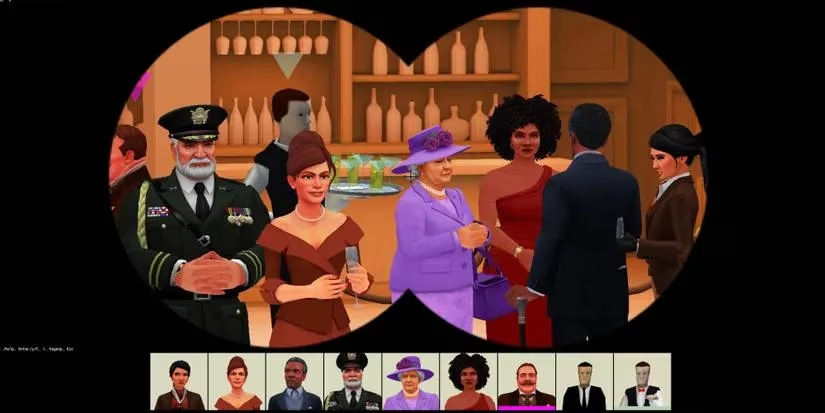
If GNOSIA is about narrative immersion, SpyParty is about psychological tension. This competitive espionage game creates an atmosphere unlike any other. I find myself attending elegant cocktail parties, trying to complete specific missions while blending in perfectly with NPCs—all while a sniper watches my every move from a distant window. The genius of SpyParty lies in its focus on human behavior. As the spy, I must:
-
Complete objectives like swapping statues or making contact
-
Mimic the movements and patterns of AI guests
-
Avoid drawing attention through unnatural behavior
Meanwhile, as the sniper, I'm scanning the party for the slightest hint of human-controlled behavior. Is that guest lingering too long near the bookshelf? Did someone just complete three objectives in rapid succession? The game creates this beautiful cat-and-mouse dynamic where victory often comes down to who can better understand and manipulate human psychology. In 2026, with numerous updates, the game offers even more missions, venues, and behavioral patterns to master.
Eville: Fantasy Betrayal in a Magical Village

Sometimes I want my deception with a side of magic and medieval charm, and Eville delivers exactly that. This multiplayer RPG transports me to a beautifully designed fantasy realm where I'm either a concerned villager trying to solve mysterious murders or the perpetrator hiding in plain sight. The village setting adds layers to the social deduction formula:
-
Day/night cycles that change gameplay dynamics
-
Magical abilities and curses that players can use
-
Multiple roles with unique powers and objectives
What I appreciate most about Eville in its current 2026 iteration is how it encourages role-playing. I'm not just voting someone out; I'm gathering in the town square, hearing accusations, defending myself with crafted alibis, and watching as alliances form and crumble based on convincing performances. The fantasy elements—like casting suspicion-diverting spells or using magical items to gather information—add creative twists to the classic formula. It's a game where my ability to tell a compelling story is just as important as my deductive skills.
Dread Hunger: Survival and Betrayal in the Arctic

For those times when I crave high-stakes tension with survival elements, Dread Hunger remains unmatched. This social deduction horror game places me and seven others on a 19th-century warship navigating treacherous Arctic waters. Two of us are traitors using blood magic to sabotage the voyage. The combination of survival mechanics with social deduction creates an incredibly immersive experience. As a loyal crew member, I must:
-
Manage hunger, warmth, and resources
-
Help repair the ship and complete objectives
-
Identify traitors while they secretly undermine our efforts
As a traitor, I'm practicing dark rituals, poisoning food supplies, and creating obstacles—all while maintaining my cover. The Arctic setting isn't just backdrop; it's an active threat. Blizzards reduce visibility, wildlife attacks the unprepared, and the cold is a constant enemy. In 2026, the game has expanded with new maps, supernatural threats, and even more complex sabotage options. Dread Hunger asks: How well can you maintain your humanity (or hide your monstrosity) when survival is on the line?
Goose Goose Duck: Free-to-Play Family Fun

Not every social deduction session needs to be high-stakes horror or complex espionage. Sometimes, I just want to gather with friends of all skill levels for some lighthearted deception, and Goose Goose Duck has been my go-to choice for exactly that. This free-to-play game features adorable avian characters completing tasks on a spaceship while trying to identify the malicious ducks (and other special roles) among them. What makes it particularly accessible in 2026:
-
Simple controls and intuitive gameplay
-
Numerous maps and game modes
-
Family-friendly content suitable for all ages
-
Active community and regular content updates
The game's charm lies in its accessibility. I've played with seasoned gamers and complete beginners, and everyone picks up the mechanics quickly. Yet beneath the cute exterior lies surprisingly deep strategy. The numerous roles—from the loyal goose to the mischievous duck to neutral parties with their own agendas—create endless combinations and gameplay scenarios. It's proof that social deduction doesn't need to be complex to be compelling.
Project Winter: Survival and Social Dynamics in the Snow

Project Winter holds a special place in my gaming memories for how perfectly it blends survival mechanics with social deception. The cozy art style belies the tense gameplay as I find myself stranded in a winter wilderness with seven others. Some of us are survivors trying to escape; others are traitors working to ensure we don't. The survival elements force cooperation:
-
Gathering resources like food and materials
-
Repairing communication equipment to call for rescue
-
Braving wildlife and weather to complete objectives
But this necessary cooperation creates the perfect environment for betrayal. As a traitor, I might secretly break repaired equipment, lead survivors into bear territory, or poison the food I'm "helping" to gather. As a survivor, I'm constantly evaluating: Is that player genuinely lost, or are they leading us into a trap? Are resources disappearing because of poor management or deliberate sabotage? The 2026 version has expanded with new maps, events, and roles that keep the experience fresh even after hundreds of hours.
Among Us: The Modern Classic That Started It All
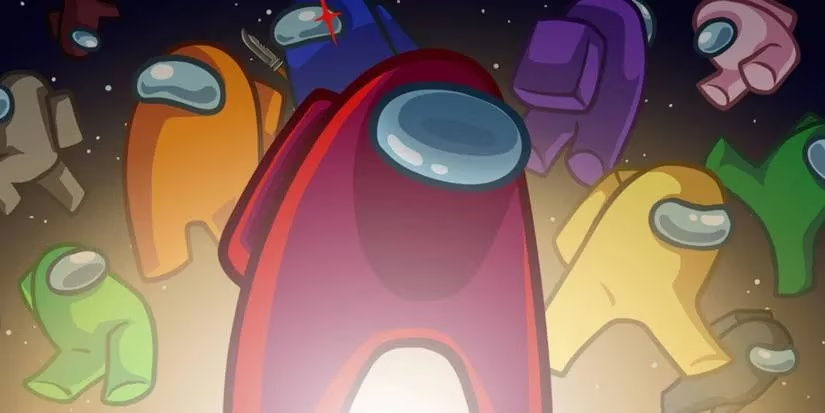
It's impossible to discuss social deduction games without mentioning Among Us. Even in 2026, this modern classic remains incredibly popular, and for good reason. Its simple premise—crewmates complete tasks while impostors sabotage and eliminate—belies incredibly deep social dynamics. What continues to amaze me about Among Us is how it distills social deduction to its purest form. The gameplay loop is straightforward, yet each round tells a unique story through player interactions. I've seen friendships tested, unlikely alliances formed, and brilliant deductions made from the smallest behavioral clues. The game's enduring popularity has led to continuous updates, including:
-
New maps with unique mechanics
-
Additional roles beyond crewmate and impostor
-
Customizable game settings for endless variety
-
Cross-platform play that brings everyone together
Among Us taught me that sometimes the simplest systems create the most complex social interactions. A game where communication and observation are your primary tools proves that you don't need complex mechanics to create compelling gameplay—you just need to understand human nature.
The Evolution of Social Deduction: Looking Forward
Reflecting on these games, I'm struck by how the social deduction genre has evolved. From the narrative depth of GNOSIA to the psychological tension of SpyParty, from the survival challenges of Dread Hunger to the accessible fun of Goose Goose Duck, each game brings something unique to the table. What ties them together is their understanding of what makes social deduction so compelling:
| Element | Why It Works | Example Games |
|---|---|---|
| Social Dynamics | Creates authentic player interactions and emergent stories | Among Us, Eville |
| Role Asymmetry | Different players have different information and goals | Dread Hunger, Project Winter |
| Observation & Deduction | Rewards careful attention to details and patterns | SpyParty, GNOSIA |
| Accessible Core Loop | Easy to learn but difficult to master | Goose Goose Duck, Among Us |
| Thematic Immersion | Settings and stories that enhance the deduction experience | GNOSIA, Dread Hunger |
As I look to the future, I'm excited to see how this genre will continue to evolve. Will we see more integration with emerging technologies? More complex narratives? New twists on the classic formula? One thing's for certain: as long as humans enjoy testing their wits against one another, social deduction games will continue to thrive, creating those perfect moments of tension, revelation, and shared laughter that make gaming such a special hobby. After all, isn't that what gaming is all about—connecting with others through shared experiences, even if those experiences involve a little (or a lot of) deception?