
For decades, the digital landscapes of video games have served as both a reflection and a refraction of societal norms, often mirroring the world's imperfections alongside its aspirations. Historically, the industry has been a stage where gender stereotypes were not merely performed but reinforced, casting characters in rigid molds: the stoic, unemotional male hero and the passive, hyper-sexualized female in distress. Yet, beneath this surface, a quiet revolution has been brewing, one pixel at a time. By 2026, this evolution has blossomed into a vibrant tapestry of narratives where identity is not a cage but a canvas. A new generation of games and their enduring classics now champion characters who defy convention, not as a political statement, but as an authentic expression of human complexity. These stories challenge players to reconsider why such norms ever existed, offering worlds where strength is not gendered, emotion is not a weakness, and authenticity is the ultimate power.
🌸 The Garden of Gentle Souls: OMORI's Defiant Bloom
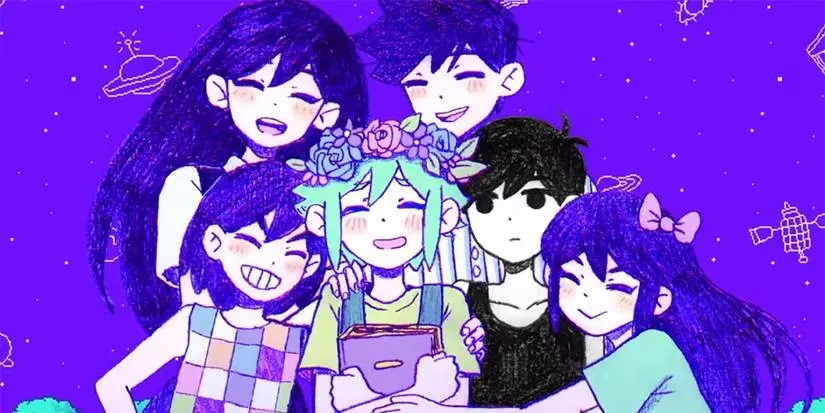
The poignant and psychologically rich world of OMORI is a masterclass in subtle subversion. Within its haunting narrative, characters exist in a state of raw, emotional truth, effortlessly dismantling gendered archetypes. The protagonist, Omori, and his friends navigate trauma with a vulnerability rarely afforded to young men in media. Central to this is Basil, a character who embodies a serene rejection of toxic masculinity. His passions lie in the delicate cultivation of flowers and the creation of art—pursuits traditionally coded as feminine. In the dreamlike Headspace, his pastel-green hair and floral crown are not mere aesthetics but symbols of his gentle spirit, proving that sensitivity and strength are not mutually exclusive.
Conversely, Aubrey subverts expectations from the opposite direction. She occupies the role of the hardened, sometimes violent bully—a trope almost exclusively reserved for male characters. Her toughness, born from profound pain and unresolved anguish, presents a young girl who is allowed to be difficult, angry, and complex. OMORI's brilliance lies in this nonchalant normalization; it presents a cast that is authentically themselves, making their defiance of convention feel not like a rebellion, but simply a state of being.
🎭 The Monstrous Masquerade: Celebration of Self in Monster Prom
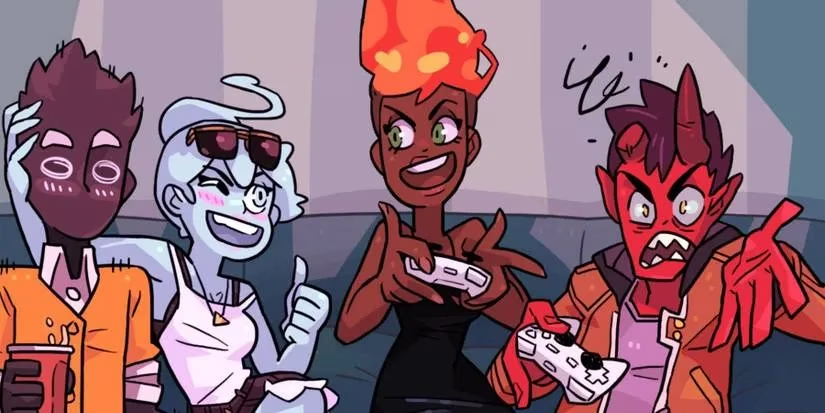
Where OMORI explores depth through melancholy, Monster Prom celebrates identity through exuberant, inclusive chaos. This dating simulator throws traditional romantic paradigms out the window, offering a vibrant spectrum of self-expression. From its very inception, the game empowers the player, allowing them to choose their avatar's name and pronouns, establishing a foundation of respect for personal identity. The roster of romanceable characters is a delightful parade of non-conformity:
-
Polly Geist: The life-of-the-party ghost who defies quiet, demure femininity.
-
Milo Belladonna: A flirtatious, confident influencer who challenges stoic masculinity.
-
Various non-binary characters and individuals whose identities and presentations exist outside the binary.
The game’s core mechanic—choosing whom to ask to the prom—is itself a subversive act, dismantling the gendered rituals of traditional courtship. Monster Prom creates a world without judgment, where every monster, whether a shy sea creature or a flamboyant demon, is celebrated for their authentic self. Its numerous endings and events weave a rich tapestry of LGBTQ+ narratives, proving that inclusivity can be as fun and engaging as it is meaningful.
🛡️ The Original Sentinel: Jill Valentine's Enduring Legacy
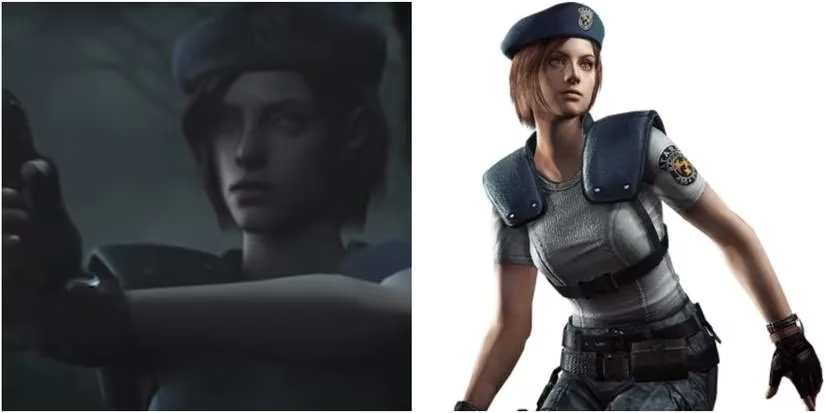
Long before it became a broader movement, a revolution began in the shadowy corridors of the Spencer Mansion. Jill Valentine of Resident Evil emerged not as a damsel, but as a definitive equal—a landmark moment for female representation. Director Shinji Mikami's conscious rejection of the hyper-sexualized media tropes of the 90s resulted in a character whose design was pragmatic: sensible, combat-ready attire that signaled her role as a highly trained S.T.A.R.S. operative. This was a radical departure in an era where female characters were often visually objectified.
Jill’s significance extends beyond her uniform. She is portrayed with profound dimensionality—capable of strategic brilliance and palpable fear, demonstrating that courage is not the absence of vulnerability. She is neither unnecessarily brutal nor sentimentally soft; she is a professional navigating a nightmare. Her legacy as an iconic character endures because she was written as a complete person first, whose gender informed but did not confine her capabilities. She paved the way for a future where a woman's strength is assumed, not astonishing.
🌍 Partners in Adventure: The Duality of Elena and Chloe
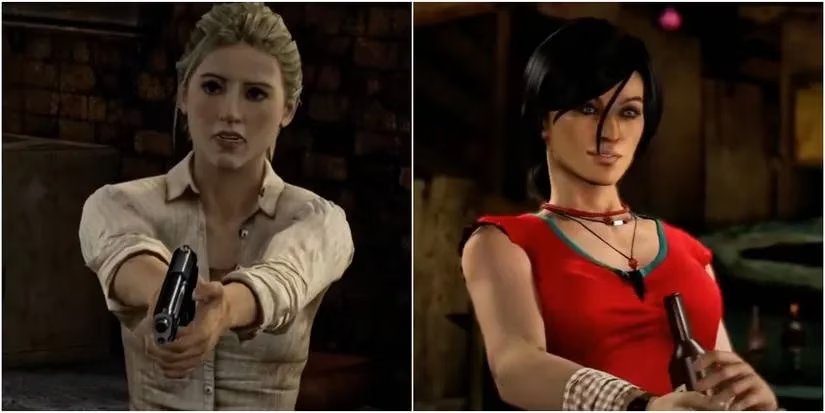
Uncharted 2: Among Thieves brilliantly showcases how two women can defy conventions in completely divergent, yet equally valid, ways. Elena Fisher and Chloe Frazer are not mere satellites to Nathan Drake; they are compelling protagonists of their own narratives. Elena, a tenacious journalist, possesses a strong moral compass that remains unshaken by Drake's morally grey escapades. Her love for history and adventure equals his, making their relationship a partnership of intellectual and emotional equals. She is a love interest written with full agency, whose convictions are as integral to the plot as her combat skills.
Chloe, in contrast, operates in shades of grey. A self-proclaimed mercenary, she is shrewd, adaptable, and refreshingly self-interested. While she flirts with the 'femme fatale' archetype, she subverts it through her sheer competence and layered motivations. Her ability to hold her own in any situation, explored further in Uncharted: The Lost Legacy, cements her as a formidable independent force. Both women are dressed appropriately for their globe-trotting, peril-filled lives, their clothing serving function over fantasy. Together, they represent a spectrum of femininity—one driven by ethics, the other by pragmatism—both portrayed as tough, brave, and utterly real.
💔 The Weight of Existence: Trauma and Transcendence in The Last of Us Part II
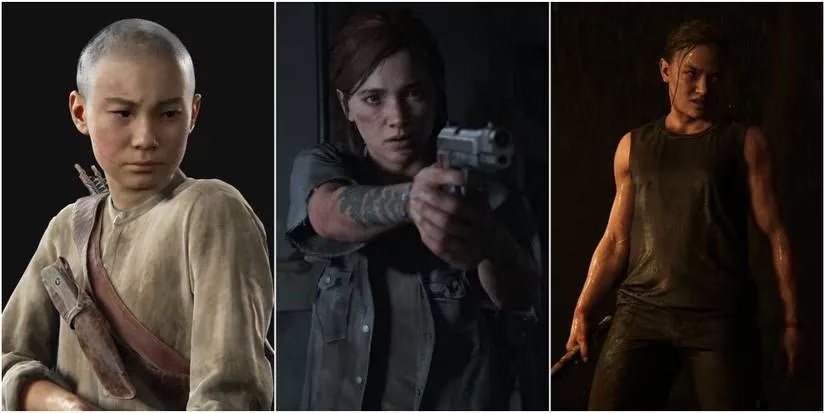
The Last of Us Part II stands as a monumental work in the deconstruction of gender, using its harrowing post-apocalyptic setting to strip away societal pretenses. In a world defined by survival, traditional conventions become irrelevant, allowing characters to be defined solely by their humanity. At its heart are three extraordinary figures:
| Character | How They Challenge Convention | Core Identity |
|---|---|---|
| Ellie | A lesbian protagonist whose toughness and resilience are never questioned; she rejects performative femininity. | A hardened survivor motivated by love, loss, and vengeance. |
| Abby | Depicted with pronounced musculature and brute strength, challenging the scarcity of physically imposing female leads. Her design sparked debate, highlighting ingrained biases. | A soldier grappling with guilt, seeking redemption, defined by her physical and emotional rigor. |
| Lev | A transgender teenager whose identity is central to his story; he bravely rejects the rigid dogma of his community to live authentically. | A resilient and compassionate soul seeking peace and acceptance. |
Ellie and Abby are mirrors of trauma and strength, their gender becoming almost incidental to their profound, flawed humanity. They are treated with the same narrative weight and moral complexity as any male character. Lev’s journey is particularly groundbreaking, offering a rare, respectful portrayal of a transgender character in a AAA title. His perseverance in the face of persecution is a powerful testament to the strength required to be one’s true self. The game argues that in the crucible of extreme experience, the only conventions that matter are those of the human heart.
By 2026, these games and the countless others they have inspired are not outliers but harbingers of a matured artistic medium. They prove that interactive stories can be both profound playgrounds and powerful catalysts for empathy. The pixelated heroes and heroines within them teach a timeless lesson: true character lies not in conforming to a role prescribed by gender, but in the courageous, messy, and beautiful act of being.