
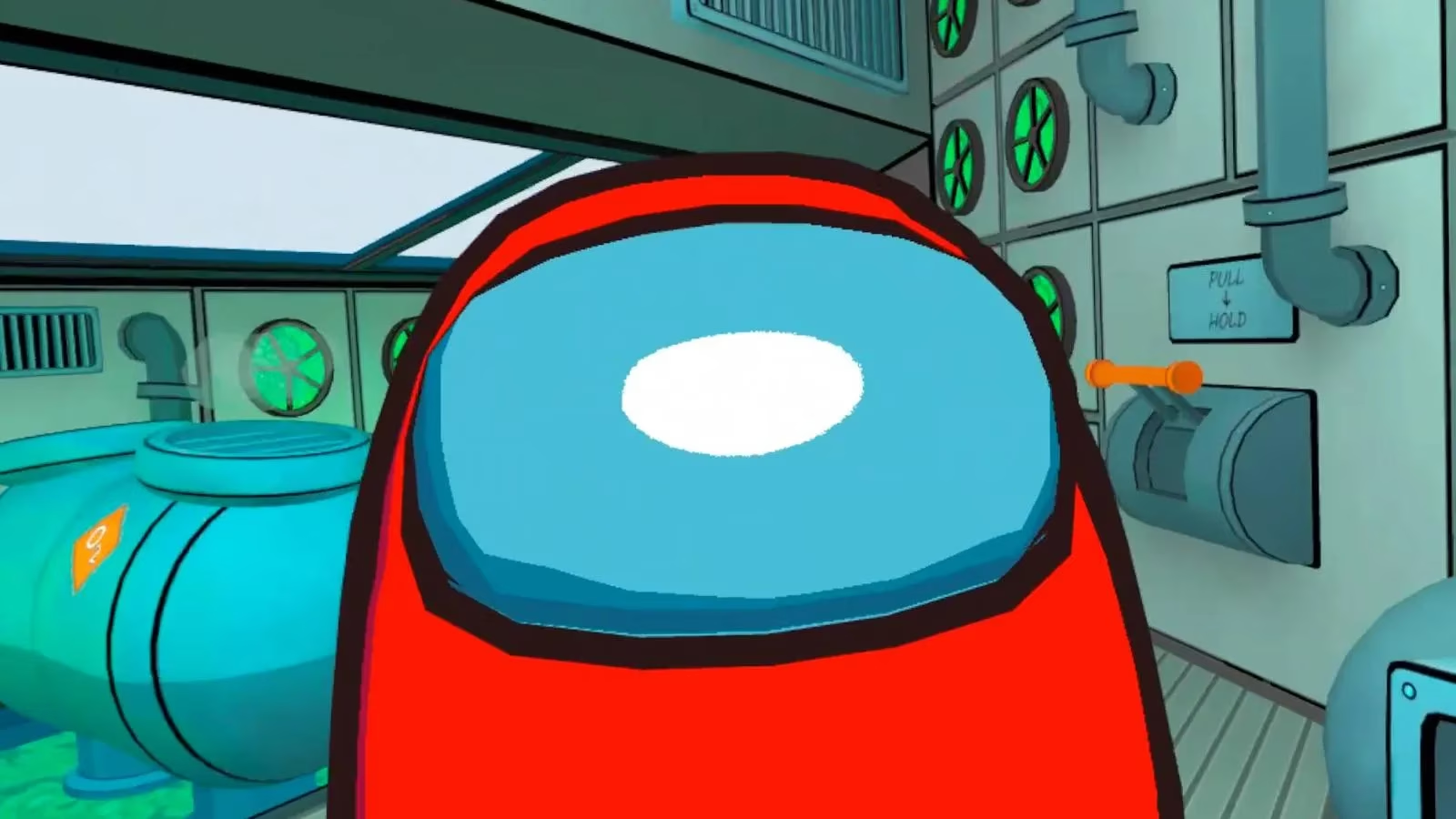
The cold hum of the Skeld was never meant to be felt—until now. In the luminous VR reincarnation, the red Crewmate’s own breath fogs the inside of his helmet, a ghost of surprise escaping as he scurries past the cafeteria tables. It’s 2026, and while the flatscreen original gave us suspicion, the VR rendition gifts us presence. Every shadow cast by a reactor beam, every flicker of a distant corridor light—they don’t just set the mood; they are the mood, wrapping around your spine like the chill of deep space. The game, having launched as a holiday season promise way back in ‘22, has aged like fine ejected stardust. Innersloth, the quiet alchemist behind this phenomenon, transmuted a 2D social deduction gem into a full-body psychological tango where your trembling hands can betray you faster than your alibi.
The New Rhythm of Suspicion
Remember the old days, when a crewmate’s innocence hinged entirely on a chat box? That’s so sus was a text you typed with greasy thumbs. In VR, sus is a full-body language. It’s the subtle way Cyan lingers half a second too long at the task panel, or how Yellow’s footsteps echo too fast in the engine room. The game demands a dance—each motion meticulously considered, like a ballet performed on the razor’s edge of trust. Players don’t just walk; they glide with the silent prayer that their avatar’s head-tilt won’t be mistaken for a murderer’s glance.
The trailer once teased us with a scene of frantic pointing around the Emergency Meeting button, a moment that now defines every round: physical hands jabbing at the air, accusations flying like volatile asteroids. “It’s yellow, bruh, I saw him slice the wires.” And poor Yellow, standing there in his sunny innocence, gets voted into the void with a chorus of “gg.” In the VR realm, being spaced has never felt more personal. You watch your virtual body drift away while the ghost chat becomes a spectral therapy session.
From Pancake to Presence
Let’s call the original game pancake mode—flat, delicious, but ultimately a screen. VR injects dimension not just into the maps, but into the very essence of deception. The Skeld, Mira HQ, and Polus have been rebuilt as playgrounds of paranoia where you can literally peek around corners, crouch beneath vents, and feel the vibration of a sabotage in your controllers. The classic caf\u00e9 setting, once a pixelated haven, now blooms with interactive tables and chairs that you can knock over in a panic\u2014much to the delight of any lurking imposter. And those tight corridors? They’re claustrophobic canvases where trust dies between heartbeats.
Here’s a slice of what’s changed:
| Element | Pancake Among Us | VR Among Us |
|---|---|---|
| Movement | Point-and-click, joystick glide | Physical walking, teleport, smooth loco |
| Tasks | Mini-game pop-ups, purely visual | 3D interactions: pulling levers, welding actual panels |
| Kills | Animated cutscene from third-person | First-person reach-and-touch, a whisper-quiet snap |
| Meetings | Text/voice chat in a static screen | Standing in a circle, voice proximity, wild hand gestures |
| Venting | Simple jump animation | Crouching, physically climbing into a vent (requires guts!) |
It’s the little things\u2014like the way your heartbeat audibly races when an imposter is near, a feature that initially gifted the bad guys a massive advantage, as many a Gamerant scribe predicted. Nowadays, skilled Crewmates learn to master their own pulse, turning that bio-feedback into a sixth sense. Talk about keeping it cool.
The Imposter’s Euphoria
Playing the villain in VR is a symphony of sadism and stage fright. Gone is the safety of a keyboard; your own two hands become the weapons. When you stride into Electrical, the room’s humming silence is your canvas. You spot Lime innocently calibrating the distributor, their back turned. The kill isn’t a button press\u2014it’s a lunge. A physical motion that requires nerve, timing, and an empty corridor. Afterwards, you have a split second to vent and flee, your real-world body crouching and twisting like a contortionist. The adrenaline is a cocktail of guilt and glee, a feeling old-school pancake players could only dream of.
And then comes the meeting. Standing in that circle, feeling the literal heat of other players’ avatars, their helmets turning toward you. You’ve got to sell the lie with your whole body. A shrug here, a well-timed point at Blue there. “Nah, I was in Navigation, charting the course. Didn’t see anything.” The beauty of it is that VR turns everyone into a method actor. Even the most stone-faced gamer can’t help but twitch when accused, and that twitch\u2014that microscopic failure of composure\u2014is often the hanging rope.
Community Vibes & Cosmic Updates
Fast forward to 2026, and Among Us VR has cultivated a community that is as creative as it is chaotic. Custom lobbies are themed soirées; some nights you’re in a “no-kill dating sim” where Crewmates attempt to woo each other in the O2 gardens, and other nights it’s a “horror mode” where the lights are permanently off and the imposter uses a voice changer. Innersloth has dropped collaboration skins that feel like they walked out of a fever dream: a Ghostface robe that billows impossibly in zero-G, a Master Chief helmet that makes you an instant icon, and adorable Ratchet & Clank pets that can either be your emotional support or a dead giveaway.
The player count, settled delightfully between 4 and 10 per lobby, keeps things intimate. You learn people’s mannerisms, their favorite vent routes, the peculiar way Black always stops to admire the asteroids. It’s a social experiment wrapped in a carnival of chaos. Slang has evolved too: a report is a “snitch snap,” a perfect alibi is “sketch,” and when someone pulls off a triple kill, it’s a “vent god” moment.
A Constellation of Memories
One cannot talk about this remix without bowing to its roots. The Skeld’s cafeteria remains the heart of the cosmos, where alliances are born and betrayals celebrated. The image of a VR Crewmate running from the MedBay to the Reactor, their breath quickening, is poetry\u2014an iambic pentameter powered by panic. When the final two stand alone, the world shrinks to a duel of wits. The imposter, mask finally off, can choose to toy with their prey: a slow walk, a taunting wave, before the inevitable lunge. And the last Crewmate, heroically finishing their tasks with a trembling hand, experiences a triumph sweeter than any flat-screen victory. It’s the difference between watching a thriller and being inside it.
As the logo fades and the lobby reforms, the meta-store wishlists of yesteryear have long become a thriving reality. Among Us VR isn’t just a port; it’s a rebirth. It took the core loop of suspicion and camaraderie and melted it into a medium where you can literally look your accuser in the eye. So, suit up, space beans. The void is waiting, and out there, everyone can hear you scream—or snicker.
TL;DR 🚀: VR turned Among Us from a clever party game into a full-body dramatic experience. Every twitch is a tell, every meeting a stage, and every kill a heart-pounding lunge. Whether you’re a Crewmate clutching tasks or an Imposter savoring the dance of deception, the stars have never felt so thrillingly, terrifyingly close. Stay sus, friends. ✨