
Hey everyone! Ever stopped to think about how a tool you could pick up at your local hardware store has become one of the most iconic and versatile items across countless video games? It's pretty wild, right? We're surrounded by fictional arsenals of plasma rifles, enchanted swords, and gravity-defying hammers, yet the simple, unassuming crowbar holds a special place in our digital hearts. As a gamer myself, I've always found it fascinating. What is it about this piece of bent metal that developers and players keep coming back to, year after year? Is it the satisfying thunk of impact, the pragmatic utility, or the sheer absurdity of facing down alien overlords and zombie hordes with a construction tool? Let's dive into the world of gaming's most reliable multi-tool and see why, even in 2026, it's still a staple.
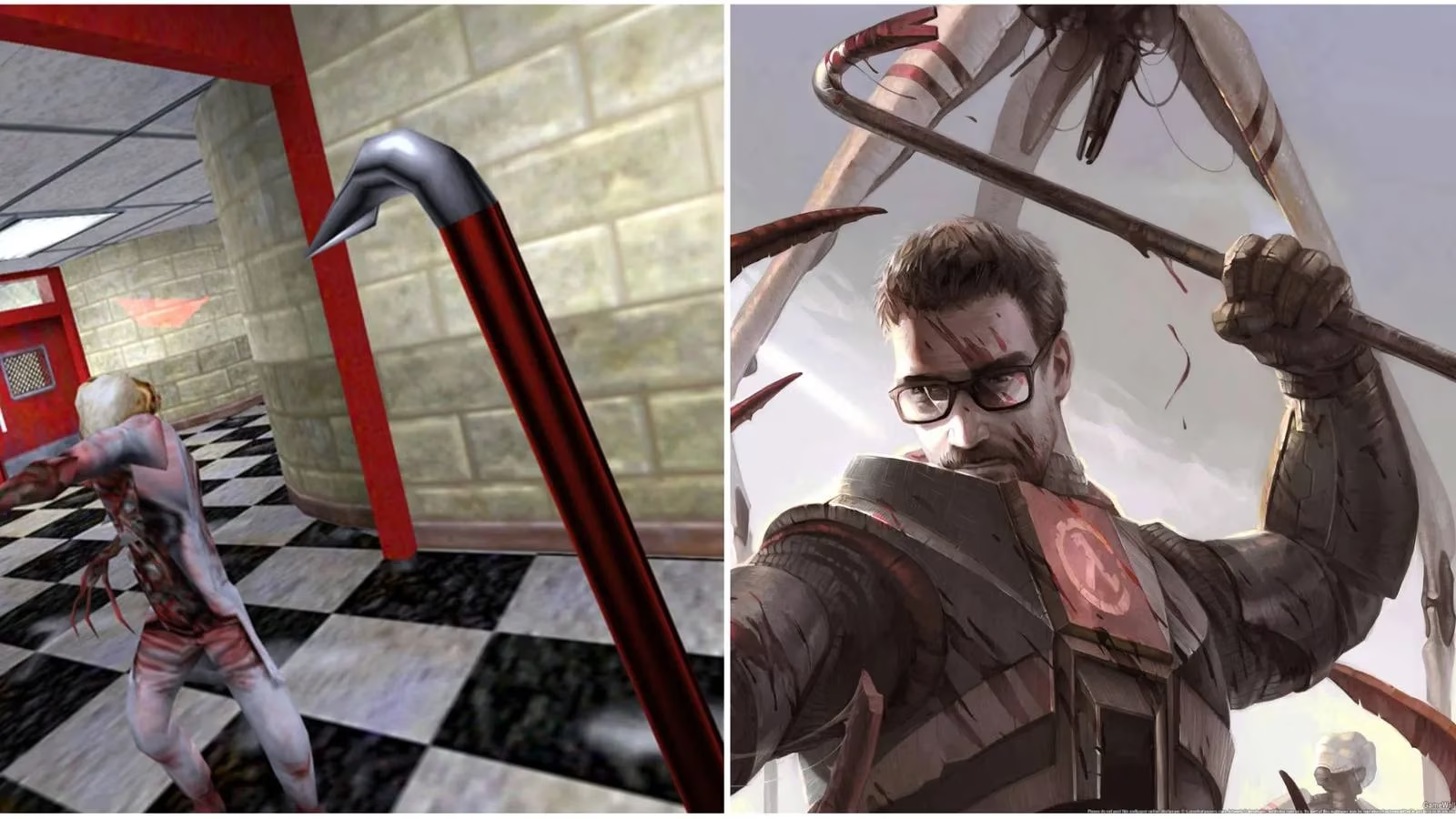
The Silent Assassin's Best Friend 🤫
You wouldn't think a blunt, clunky crowbar would be the first choice for a master of stealth, would you? Yet, in the world of Agent 47, it's practically a Swiss Army knife. Throughout the Hitman series, finding a crowbar tucked away in a garage or warehouse is like striking gold. Sure, a lockpick is quieter for getting through doors, but can a lockpick...
-
Create a loud distraction to lure a guard away from their post?
-
Be hurled across a room to knock someone out cold from a distance?
-
Serve as a non-metallic tool to bypass a pat-down? (Okay, that last one's a stretch, but in-game logic is a beautiful thing!)
The crowbar is the tool for the assassin who values flexibility over subtlety. It’s for those moments when the plan goes sideways, and you need to improvise. It’s loud, it’s brutal, and it gets the job done. As 47 himself might think (in his wonderfully monotone way), efficiency is key, and the crowbar is nothing if not efficient.
From Street Brawls to Tonfa Mastery 🥋
Now, let's shift from calculated silence to the roaring, neon-drenched streets of Kamurocho. In the Yakuza/Like a Dragon series, where most fights are settled with fists, feet, and the occasional bicycle, the crowbar holds a unique place. You can buy one from a weapon shop, and it's a solid, if unremarkable, blunt instrument. But then Yakuza 0 came along and gave it a story. Remember Goro Majima's journey?
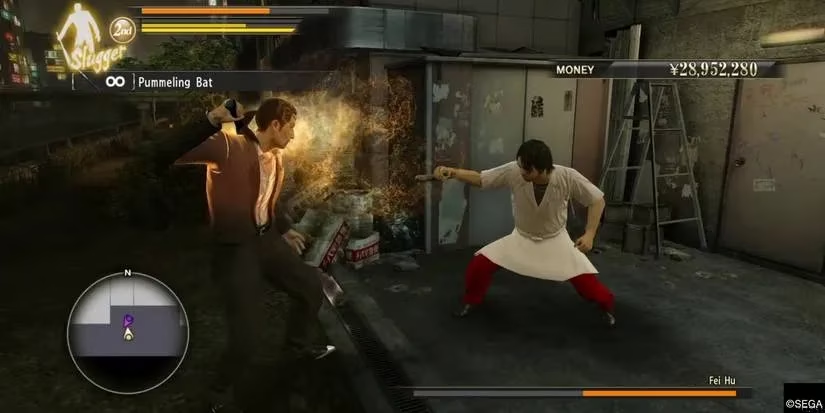
To wield the crowbar effectively, he had to train under the enigmatic Fei Hu, learning to spin and swing it like a tonfa. This transformation is what makes it special. It’s not just a weapon you pick up; it’s a skill you earn. That sense of progression, of mastering a seemingly ordinary object, makes every swing feel more impactful. It turns a piece of scrap metal into an extension of the character's will. Isn't that more rewarding than just finding a super-powered sword in a chest?
The Ultimate Parkour Tool 🏙️
If you thought crowbars were just for hitting and prying, Sunset Overdrive said, "Hold my energy drink." In a world exploding with color, mutants, and over-the-top action, the humble gray crowbar became your primary key to the city’s skyline.
| Function | Description |
|---|---|
| Melee Combat | Your first non-gun weapon for dealing with OD up close. |
| Environmental Interaction | Prying open gates and doors, as expected. |
| Advanced Traversal | This is the big one: Using it to latch onto and ride ziplines between rooftops! |
Even if you equipped a fancier melee weapon later, you never ditched the crowbar. It was permanently part of your navigation kit. This brilliant design choice cemented it not as a weapon you outgrow, but as a fundamental part of the game's identity. Who knew a tool for opening crates could also be the key to the most exhilarating urban parkour?
A Legacy of Power... and Nerfs 😅
The Saints Row series has a complicated history with our favorite tool. In the original game, the crowbar was the undisputed king of melee. Forget baseball bats and police batons; this was the top-tier instrument for up-close personal introductions. Fans loved its satisfying heft and effectiveness.
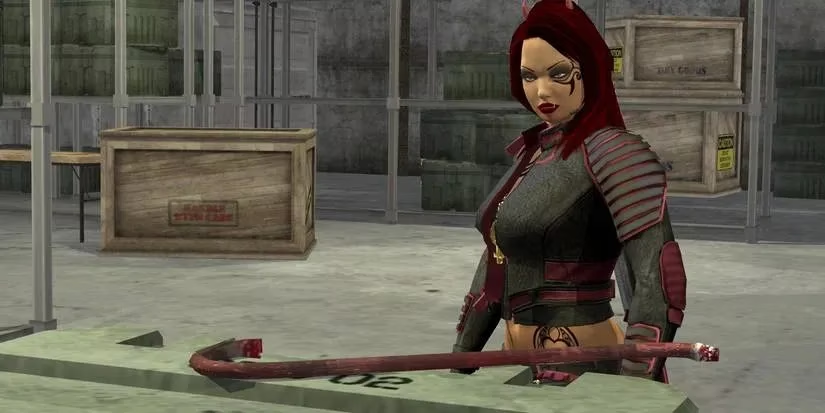
Then came Saints Row 2 and the later reboot. What happened? The crown slipped. The crowbar was nerfed, often lacking the range or raw damage of other options. It became a reliable, nostalgic choice rather than the dominant force. For veterans, though, it's a callback to the roots of the Third Street Saints—a symbol of where they started before they had dubstep guns and fought aliens. Sometimes, you just want to keep it classic, right?
More Than a Weapon: A Character's Conviction 🧟
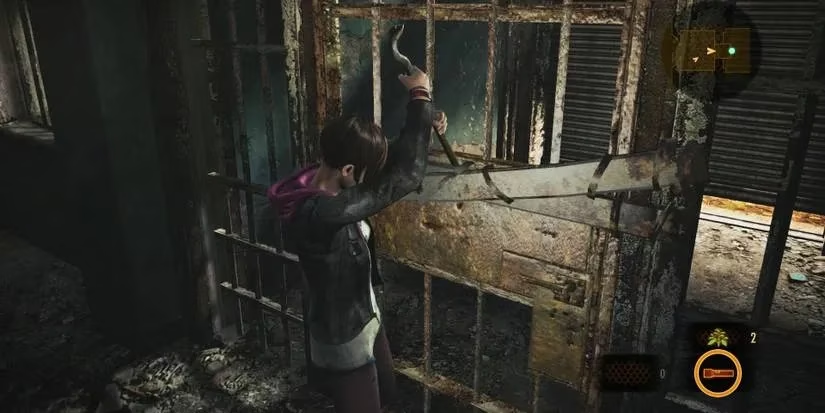
Resident Evil Revelations 2 gave the crowbar a soul by tying it directly to a character's trauma and philosophy. Meet Moira Burton. She refuses to use guns due to a past tragedy, making the crowbar her sole means of defense and utility.
-
Primary Use: Prying open doors and progressing the story—staying true to her desire to avoid violence.
-
Secondary (Necessary) Use: Whacking zombies with its long reach and a unique ground attack to keep them down.
The catch? It can't perform stealth kills. This limitation was frustrating but also perfectly aligned with Moira's character. You weren't just using a tool; you were embracing her pacifist-leaning mindset in a world gone mad. The crowbar became a lifeline and a symbol of her resolve, making it unforgettable long after the credits rolled.
An Icon of Villainy 🃏
Now, for something darker. In the DC universe, the crowbar is forever stained with one of comics' most infamous acts of brutality. The Joker used one to torture and murder Jason Todd, the second Robin. Video games have not shied away from this legacy.
-
Batman: Arkham Knight: Uses flashbacks to depict this horrific event, with the crowbar as the central, terrifying prop.
-
Injustice Series: The Joker is a playable fighter, and his crowbar is a core part of his move set. Interestingly, while you can customize much of his gear, the crowbar often remains constant. Why? Because it's instantly recognizable. It’s not just a weapon; it's a piece of character history, a symbol of the Joker's chaotic cruelty that resonates with every swing.
It's a stark reminder that in the right (or wrong) hands, even the most mundane object can become an icon of terror.
The One That Started It All For Many 🧪
And of course, we have to talk about the crowbar. Can you even have this conversation without mentioning Gordon Freeman and Half-Life? For a generation of players, this was our first digital tool. It was more than a weapon; it was a key to survival in the Black Mesa Research Facility and later City 17.
Think about its roles:
-
Companion: Your first line of defense against headcrabs and zombies.
-
Key: Smashing open crates for precious ammo and health.
-
Pathfinder: Breaking through barricades and solving simple environmental puzzles.
It was perfectly balanced—useful enough to keep around but not so powerful that you'd rely on it exclusively. It represented Gordon's everyman genius: using whatever was at hand to fight an interdimensional invasion. The crowbar wasn't just in the game; it was the game's spirit of improvisation and resilience. Its return in Half-Life 2 was a moment of pure, nostalgic joy for fans. It felt like coming home, even if home was overrun by Combine soldiers.
So, there you have it. From stealthy takedowns and acrobatic travel to deep character symbolism and legendary status, the crowbar’s journey in gaming is anything but simple. In 2026, we're still seeing new games find clever ways to incorporate it. It's a testament to great game design: sometimes, the most compelling tool isn't the most fantastical, but the most relatable. It grounds us, it empowers us, and it reminds us that ingenuity often beats sheer firepower. The next time you boot up a game and spot a rusty crowbar leaning against a wall, give it a little nod of respect. You're not just picking up a weapon; you're picking up a piece of gaming history. 🛠️🎮