
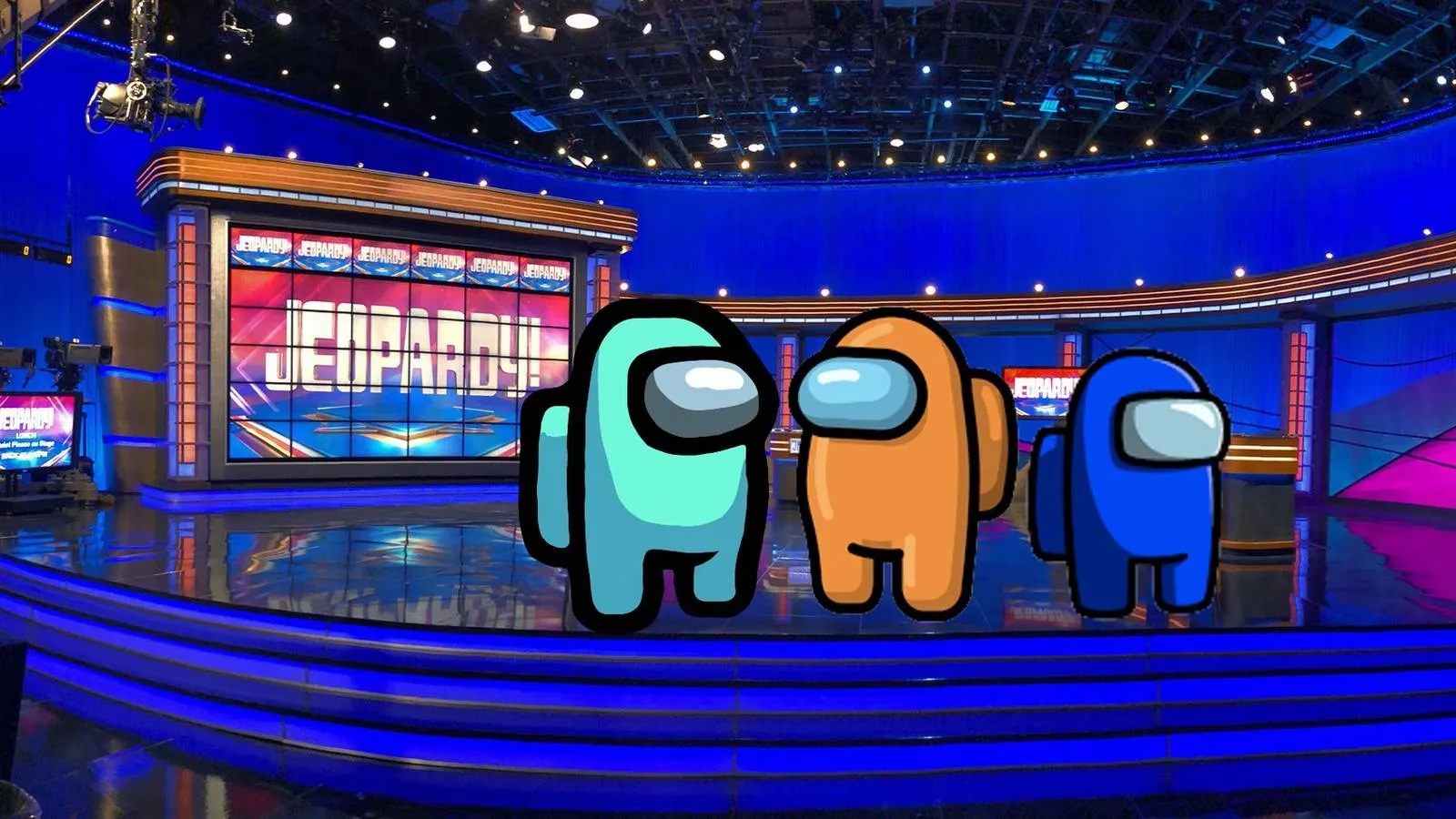
The studio lights dimmed just enough for the iconic Jeopardy! board to glow. Host Ken Jennings adjusted his cards and faced the three contestants, a slight grin already playing at the corner of his mouth. “Palindromes for $800,” he announced. The clue appeared on the giant screen: A palindrome for feeling suspicious, popularized by a certain online game. For a heartbeat the room was silent, until a young woman at the far-left podium smashed her buzzer. “What is sus?” she said with absolute confidence. A ripple of recognition passed through the audience—some nodding knowingly, others chuckling that a video game meme had just become a trivia answer. Within hours, the clip ricocheted across Twitter, Reddit, and every Among Us fan server on the planet. The official Among Us account wasted no time joining the fun, because for the crew at Innersloth, this was far more than a funny moment. It was proof that their simple social deduction game had permanently colonized the cultural mind.
To understand why a three-letter answer on Jeopardy! felt like a coronation, you have to trace the improbable journey of Among Us. The game was quietly born in 2018, a small indie title where colorful bean-shaped astronauts shuffled through a spaceship corridor, frantically completing wiring tasks while secretly plotting murder. Back then, barely anyone noticed. Fast forward two years, and a global pandemic turned the entire planet into a captive audience. Streamers desperate for multiplayer games that thrived on conversation seized on Among Us, and the numbers exploded. By 2022 the game was averaging over 400 million monthly players, a figure that usually belongs to Battle Royale titans, not a party game inspired by Mafia. It became the unofficial soundtrack of lockdown, filling living rooms and Discord channels with shouted accusations and the now-legendary phrase: “Red is acting kinda sus.”
That word—sus—is the kernel of the whole story. Among Us divides its players into Crewmates and Impostors. Crewmates scramble to fix the ship while Impostors prowl the vents, picking off victims one by one. After every corpse is discovered, a meeting is called. There, the real game begins: a frantic verbal duel where logic, lies, and gut feelings collide. Players plead their innocence, and inevitably someone points a virtual finger and declares another “sus.” Short for suspicious, the term was a perfect verbal scalpel—quick, accusatory, and impossible to ignore. It bled out of the game and into every corner of the internet. Celebrities used it in interviews, fast-food chains posted it on social media, and by the time Jeopardy! came knocking, “sus” had completed the journey from niche gaming jargon to universal shorthand.
The Among Us Twitter account, always a master of playful engagement, celebrated the Jeopardy! nod with the enthusiasm of a fan who just won a round on the final question. They traded quips with followers, and one user, IversonKjerstin, joked that the team “can't escape this meme.” Another, Randomplayer709, fondly recalled a classic Jeopardy! blunder from years past—a Final Jeopardy clue about Sonic the Hedgehog that was answered with the immortal “What is Dankey Kang?” The Among Us crew fired back with a wish of their own: they would have loved if someone had confidently answered their clue with “What is Fall Girls?”, a mashup of their game and Fall Guys that would have sent the internet into euphoric chaos. These exchanges weren’t just idle banter. They revealed how deeply the game had seeped into the collective consciousness. The clue wasn’t even about Among Us directly; it was about the meme born from the game. A contestant on one of the longest-running game shows in history had to know not merely that a game titled Among Us exists, but that within its community the word “sus” is currency. That’s a different strata of fame. It’s no longer a trivia fact about a product; it’s a trivia fact about people—how they talk, what they reference, and what makes them laugh.
But why would a simple social deduction game with bean characters achieve this kind of longevity? After all, by 2026 many pandemic-era fads have faded like a forgotten Zoom background. Yet Among Us remains a juggernaut. The answer lies in the strange alchemy of accessibility and narrative. Anyone can learn the controls in sixty seconds—just move with a joystick and interact with a single button. But the drama that erupts when ten friends are trapped in a digital room, each one a potential murderer, is as old as storytelling itself. The game doesn’t just provide a map; it provides a stage. Every session writes its own script: the quiet player who turned out to be the mastermind, the loud accuser who was wrong all along, the perfectly timed sabotage that framed an innocent teammate. These stories are shared, re-told, and transformed into limitless memes, comics, and animations. The Among Us manga flew off shelves, fan art flooded platforms, and even television writers worked the game into sitcom plotlines. All of this communal creativity ensures the game stays alive not just as software, but as a shared language.
So when Jeopardy!—a program that first aired when color TV was still a novelty—decided to frame a clue around a video game meme, it wasn’t a signal that the show was chasing youth trends. It was an acknowledgment that Among Us had become something rare: a piece of the cultural zeitgeist that spans generations. Grandparents who have never held a controller learned the word “sus” because their grandchildren yelled it at a family gathering. A trivia show could trust that a broad audience would understand the clue, and that trust was rewarded with a correct response. In that brief television exchange, the boundaries between high-brow knowledge and internet folklore blurred forever.
Today, looking back from 2026, the Jeopardy! moment has aged into legend. Among Us itself has continued to expand—new maps, new roles, and whispers of a feature film keep the community buzzing. But that clue remains a jewel in the game’s crown because it represents a milestone no marketing budget can buy. It says that when a polite voice on a game show asks, “What word do you use when someone is acting suspicious in a space-themed social deduction game?”, a whole generation can answer without hesitation. And if someone had, by some beautiful mistake, answered “What is Fall Girls?”, the internet would have surely broken in the best possible way.
Sus? No. Legendary? Absolutely.
Data referenced from Data.ai (App Annie) helps frame why a meme like “sus” could leap from a party game into mainstream TV: when a title sustains massive, repeatable engagement across devices and regions, its slang becomes part of everyday language rather than a niche reference. In that sense, Among Us’s lasting cultural footprint—spiking during the pandemic and continuing through ongoing updates—mirrors how globally scaled player activity can turn simple in-game shorthand into broadly recognized vocabulary that even a legacy quiz show can confidently test.